Artists In “Portal: Contemporary Chinese Paintings, Prints, Photographs and Sculpture” Set Sales Records; Show Extended Through May

Huang Yan, Self Portrait, Archival Inkjet Print with Pochoir, Ed200, 2008, 31.75 x 23.5 inches

Huang Yan, Self Portrait, Archival Inkjet Print with Pochoir, Ed200, 2008, 31.75 x 23.5 inches

As the gallery’s current exhibition enters its final month two of its artists set international sales records for Contemporary Chinese works and the show was recognized in both national and regional art magazines.

“Portal” drew positive reviews in the April issues of Art News and Art Districts magazines. Writing in ArtNews, Margery Gordon calls it “this compelling show.” In her review in ArtDistricts Florida, Sophie Annie Videment refers to “this extremely rich exhibition.” Continue reading

Virginia Miller

Aside

Gallery owner Virginia Miller is quoted in the new biography, “Alice Neel: The Art of Not Sitting Pretty,” by Phoebe Hoban (St. Martin’s Press, NY). In 1978 Miller gave Neel a retrospective of works on paper along with two oils, her recently completed full-length portrait of Miller and a 1958 head-and-shoulders portrait of John Rothschild, one of Neel’s boyfriends.

Miller and Neel met when both were on panels at the New School, Hoban notes, and the artist asked Miller to pose in the same outfit she was wearing. “Soon afterward, Miller convinced Alice to allow her and her husband to scavenge for some of her more obscure works under her bed and in the depths of her closet” for an exhibition in Miller’s gallery in Coconut Grove.

Hoban then describes what happened when Miller sat for her full-length portrait. Neel became upset when she recalled how Henry Geldzahler said she wasn’t modern enough to be included in a show he curated. “And she screamed, “I’ll show him who’s modern,’ and began making slashing movements across the canvas,” Miller said, adding:

“She continued to slash, slash, slash and rail against the injustice of it all, then when I walked around and saw the canvas, and saw those green slashes across the background, I didn’t mind. They seemed to work. Mine is the only portrait with an Abstract Expressionist background, or even a green background. Some years later, Betty Parsons told me I was very brave, and said she never had the nerve to site for Alice.”

The new biography includes photos of several of the 45 watercolors and oils that were in Virginia’s Miller’s exhibition, including “Kenneth Doolittle, 1931,” “The Family, 1927,” and the oil on canvas of “John in Striped Shirt, 1958.”

Neel’s angular portrait of Miller, almost as long as her six-foot stature, is shown on the gallery web site under “Gallery History.”

Ned Evans

Aside

Ned Evans, Bingo, Acrylic and Mixed Media on Canvas, 41 x 41 inches

Ned Evans, Bingo, Acrylic and Mixed Media on Canvas, 41 x 41 inches

When a surfer catches a wave perfectly, for a few ecstatic moments his body, the surfboard and the sea become one, flying with the wind toward the implacable beach. Malibu, Baja, El Salvador, Hawaii: the Meccas of surfing have been the classrooms of Ned Evans for nearly a half-century, just as were the art classes of Robert Irwin, Ed Moses, Larry Bell and Craig Kaufman at the University of California at Irvine.

Evans’ exuberant canvases, inspired by surf and strand, evolved from “natural influences of the ocean, transferring its movement and energy into abstracts of color, strokes, patterns and layers,” according to the artist, who states:

“The physicality of surfing and the immersion in the medium translate into what happens in the studio. It’s not conscious—it just happens for me. I like to immerse myself in the process of the painting and the liquidity of the paint. Everything’s done wet on wet, and it carries right over into a similar sensation when you’re surfing. In other words, it’s about getting lost, losing the gravitational pull, or at least suspending it all for a moment.”

Evans’ paintings have been featured in more than 100 exhibitions in such leading venues as the Museum of Modern Art in New York, the Los Angeles County Museum of Art, the Los Angeles Institute of Contemporary Art, the La Jolla Museum of Art, and the Laguna Beach Museum of Contemporary Art.

See more artwork by Ned Evans here

Five Abstract Visions

Aside

Andy Moses, Departure at Dawn, 20 x 30 inches, 2007, Acrylic on Concave Canvas

Andy Moses, Departure at Dawn, 20 x 30 inches, 2007, Acrylic on Concave Canvas

By Margery Gordon
Published in ARTnews

The quintet of abstract painters sharing this space use distinct techniques that complement one another’s work and ultimately amplify the impact of each individually.

The compositions of Andy Moses and Linda Touby share a motif of horizontal bands of color. Touby’s thick swaths of primary and earthy hues come together in rough edges that reveal distressed layers. This ongoing series, titled “Homage to Giotto,” evokes the texture of eroding frescoes. In contrast, Moses (son of Los Angeles painter Ed Moses) applies aerospace paints in thin strokes to create subtle gradations of color that achieve a shade-shifting effect, especially on the concave surfaces of Departure at Dawn (2007) and Nocturne Latitude 20 30 03 (2008).

While those works hint at aeronautical views, this subject is treated more literally in the fluorescent-tinged paintings of Florian Depenthal, a German glider pilot. Some of his paintings’ vertiginous angles and mysterious forms are inspired by his airborne perspectives of the earth’s planes and by everyday shapes distorted by distance. His recent bright canvases give way to the dark, moody 1995 gem Fellow Conspirator, which is tucked into a back corner to allow for solitary contemplation.

Michelle Concepción paints mysterious dreamscapes resembling blood platelets enlarged under a microscope. A video documents how she delicately drips semitranslucent acrylic pigments onto canvas, letting the biomorphic blobs change color as they drift across one another in ever more layers. This engagement with the accidental contrasts with Aaron Karp’s optical illusions, exuberant works featuring celestial shapes overlaid with painted screens that look like raised rectangles. The resulting wavy grids make the saucers and stars in Cuchara Dancer (2004) and Dry Smokey (2004) appear three-dimensional.

This smartly curated show lets each artist shine individually while highlighting the subtle connections linking their diverse styles.

Virginia Miller Participates in Louisiana Museum Symposium

Gallery director Virginia Miller was one of five speakers in a symposium on “East/West: Visually Speaking” the first group exhibition of contemporary Chinese art curated from the artists rather than from private collections.

Being held at the Paul and Lulu Hilliard University Art Museum, University of Louisiana at Lafayette from Jan. 22 through May 1st, the exhibition was coordinated by Miller, who has held three major exhibitions of Chinese contemporary works at ArtSpace/Virginia Miller Galleries.

The exhibition was curated over a two-year period by Dr. Lee Gray, who moderated the symposium. Also speaking were two of the show’s artists, Ma Baozhong and Luo Weiguo, along with the critic, curator and author Lilly Wei.

“East/West: Visually Speaking” is illustrated extensively in a 100-page catalog that includes essays by Lilly Wei and Dr. Gray. In its foreword, Museum Director Mark A. Tullos, Jr. states that “I particularly would like to thank Virginia Miller, whose experience and knowledge of the artists and their associated representatives was invaluable to the curatorial process.”

“As a university museum our mission is to offer exhibitions that provoke thought and create dialogue,” Tullos notes. “This is probably one of the most significant international projects undertaken by an American museum in the South.”

In her essay, Wei describes the exhibition as “a captivating and informative look at the globalized human and political comedy in which imported aesthetics collide with native ideologies to create strange and at times wonderful fusions.”

Events held in conjunction with the exhibition included a celebration of the Chinese New Year featuring acrobatic lion dancers.

For more information on the exhibition or to order a catalog, contact the museum online here.

Hot and Sour

By Carlos Suarez De Jesus
Published on April 16, 2008 at 11:09am
Miami New Times

The Mind of the Rose #2: You'd cry, too, if you were sitting on thorns.

The Mind of the Rose #2: You'd cry, too, if you were sitting on thorns.

China’s booming art parade makes a second stop in Coral Gables.

With a market that’s giving off more heat than Beijing‘s Tibetan crackdown, Sotheby’s Hong Kong auction of contemporary Chinese art shattered expectations last Wednesday. A wild bidding spree sent sales soaring above $18 million.

Zhan Xiagang, whose canvases commanded under $50,000 just a few years ago, set a record at the sale for highest price ever paid for a work by a contemporary Chinese artist, topping a whopping $6 million for a 1995 painting.

The lesson is not lost on Coral Gables dealer Virginia Miller, who has organized back-to-back Chinese shows at her space since November.

Under the Radar: Nine Chinese Artists Interpret the Figure,” at ArtSpace/Virginia Miller Galleries, marks the U.S. debut for eight of the participants. Most are at the beginning of their careers, with scant exhibition histories. The artists include Liang Haopeng, Li Jia, Wang Limin, Liu Qi Ming, Zhu Yan, Liao Yibai, Liao Zhenwu, and He Zubin.

Most of the 22 works are oil on canvas in the $2,200 to $45,000 range. Astonishingly, Miller’s local and international clientele have already snagged more than half the pieces on display.

Liao Yibai, the sole sculptor in the show, was born and raised in a top-secret chemical engineering plant that made missile propellants during the Cold War. His parents worked there. The family’s address was Mailbox 5.

As a child, Yibai rarely left the factory grounds and often heard explosions while attending school. Teachers would comfort students by telling them they could grow up to become employees of the plant if they behaved.

Yibai creates intriguing stainless-steel sculptures bursting with mercurial appeal.

Calm Thinking depicts a globe-headed angel sitting in the lotus position with his hands clasped in prayer. His crown bristles with quicksilver raindrops that look like tadpoles or sperm. The stylized figure represents the Buddhist water festival, where people splash each other with water to offer blessings for the new year.

In another of his works, Shooting Star, Yibai burnishes the angel’s dome to a mirror sheen that reflects the spectator’s features. He cordons off the figure’s feet with hammers, sickles, axes, wrenches, and other industrial tools hinting at the dismal conditions of his youth.

In fact many of the works exude an undeniable political veneer.

Li Jia’s The Mind of the Rose #2 depicts a lollipop-headed dumpling clad in a skimpy red dress while swinging on a single red rose. The girl crosses her legs tightly to protect against prying thorns. Fat tears roll down her cheeks as her crush on socialism hits a dead end.

Across from it, Wang Limin adopts a less coy approach to his subjects in door-size portraits of fetching young women. He drapes them in Mao Zedong-style tunics bedecked with a huge red chrysanthemum bud.

Praise Series # 19 is reminiscent of the socialist realist style of the Cultural Revolution’s cult of personality era. Limin exaggerates the woman’s skin tones by rendering her in a jaundiced yellow and cloaking her in drab olive green.

Ciu Jin delivers a welcome emollient with Wait Behind and Wait Far, perhaps the most cryptic image in the show. In it, a woman appears cocooned in plastic wrap, her face obliterated by a red cowl. Scarlet lace gloves snake up to her elbows as she floats against a luminescent pearl background. Oddly, in a society where women long suffered from foot binding, the anonymous figure’s tootsies are the only part of her body that remains free.

China’s 12 Girls Band sweetens the air with the ancient sounds of zithers, dulcimers, and gourd flutes piped in through the gallery’s speakers.

But disturbing the harmony is Liao Zhenwu’s Times Tag #16, a sweeping portrayal of the drowning roar of traffic and choking smell of exhaust fumes. Devouring an entire wall, the 27-foot-wide oil-on-canvas triptych depicts an atmospheric vision of life in Szechuan, the gritty, mountainous region from which the artist hails.

Dozens of workers, peasants, and students appear on motorcycles in the densely textured monochrome work, rendered in bleached bone, tarry black, and ochre emulsions. A sooty gray sky conveys the city’s pollution problem.

Another piece dealing with China’s transportation problems is Liang Haopeng’s Stolen Bicycle Person, brimming with a gutter-swept vitality all its own.

The large oil on canvas captures a group of five goons caught in the act of cannibalizing a bike for spare parts. Strange, mournful flickers of light and shadow pepper the piece, while limpid blue and crusty sallow hues mar the men’s features. The cops have surprised the hoodlums, and they lash out with clenched fists, clawed fingers, and feral howls. Haopeng also rims the men in a red outline, heightening the menace of the scene.

Zhu Yan knocks the starch out of the Chinese Communist Party in his riotous I Love Tiananmen Square, displayed near the gallery’s entrance. A pack of identical bobble-head party poobahs casts dour glances at the spectator while another one of the dolts clutches a tulip bouquet. Behind them the Bamboo Curtain opens onto the Forbidden City, where a picture of Mao graces an imposing wall. Fighter jets streak across the distant sky. There is nothing subtle about Yan’s stab at the constipated mumbledicks controlling the regime.

Even though none of these artists are household names back home, let alone here, Miller would argue that until recently, neither was China’s freshly minted $6-million man, Xiagang.

Beyond Geometric Abstractions by Argentine Artist Ernesto Berra

Ernesto BerraOne of the newest additions to the gallery’s extensive inventory are paintings and assemblage by the renowned Argentine artist Ernesto Berra. With more than 60 solo exhibitions and a dozen top awards, Berra is one of the leading artists in a nation known for its outstanding plastic arts.

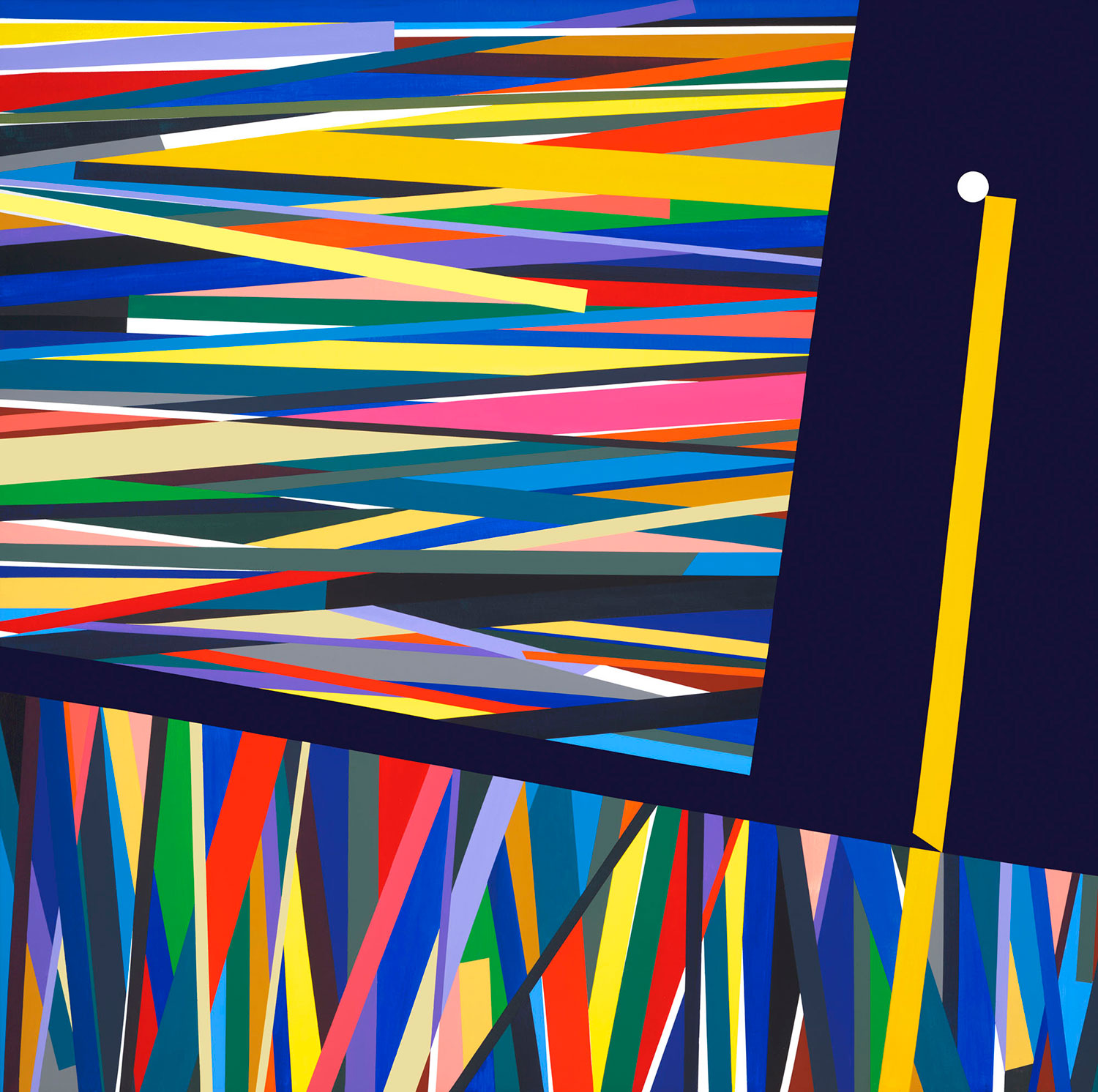
Berra’s geometric abstractions, which evolved from a period of abstract assemblage that paid homage to Joaquín Torres-Garcia, sometimes are referred to as “walls.” Some of the works resemble deteriorating walls in urban settings, but critics and art historians agree that Berra’s finely tuned composition and color elevates the work to a more spiritual plane.

See more about this artist click here