Reviews
Humberto Castro, del Erotismo al Hermetismo
By Carlos M. Luis
From Cuba to Paris, his freedom trail
By Fabiola Santiago
Preface to "Humberto Castro, The Paris Years"
by Jorge Hilker Santis
Humberto Castro, ¿Que pasa en Miami?
By ArtPremium
Humberto Castro english spanish
by Irina Leyva
Humberto Castro, del Erotismo al Hermetismo
By Carlos M. Luis
Especial/El Nuevo Herald
Artes & Letras
Posted on Sun, Dec. 17, 2006
Las primeras obras que vi de Humberto Castro me las mostró Giulio Blanc: eran unos dibujos que de inmediato me causaron una fuerte y favorable impresión. Poco tiempo después pude ver más de su producción en una exposición que hiciera en la galería Ambrosino. Desde entonces su obra quedó grabada en mi memoria como una que representa, al menos para mí, una interpretación visionaria de la realidad que incluye tradiciones que me son muy afines. Intentaré hacer una lectura de la misma partiendo de esas tradiciones que creo presentes en su pintura.
La tradición erótica. A nadie que esté familiarizado con la historia del arte, se le puede escapar el hecho de que el erotismo es una de sus manifestaciones más constantes. Todas las grandes culturas recrearon escenas cargadas de un evidente contenido sensual (aunque de trasfondo religioso) que hoy en día podrían ser tildados de pornográficos. La presencia de la mujer, como es natural, es indispensable para que se produzca ese
choque inicial que le permite a la imaginación |
|
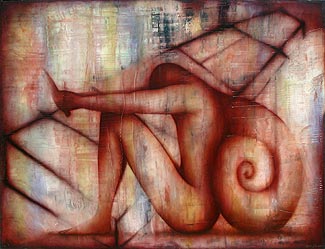
abrirse al juego erótico. En la pintura de Humberto Castro la mujer cumple esa misión como portadora de un mensaje mágico que los románticos, (pienso en Novalis al respecto) siempre le asignaron. La finura de trazo que utiliza Humberto Castro para recorrer la esbeltez de las formas femeninas, reproduciéndolas a veces como sirenas, otras como diosas o hadas etc., nos hace pensar en una fruición previa antes de la ejecución de las mismas. El erotismo pues, se mantiene vivo en toda su obra dentro de un contexto que incluye otras tradiciones.
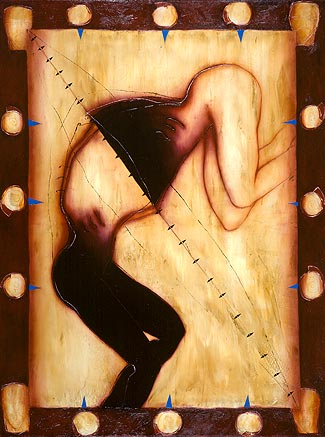
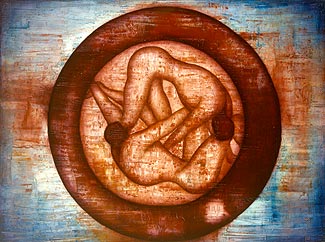
La tradición mítica-hermética. El tema del laberinto así como el de las espirales, forma parte esencial de su pintura. El laberinto aparece en las viejas culturas del Mediterráneo tanto en Egipto, en la ciudad de Heracleópolis considerado según Plinio como una de las maravillas del mundo; como también en Creta dando origen al mito del Minotauro. Los jardines-laberintos del Barroco eran la representación de una mentalidad que encontraba en la sierpe o el pliegue su expresión más acabada no ajena al pensamiento hermético. El laberinto para los alquimistas simbolizaba los obstáculos que se presentan para la realización de la Gran Obra. La espiral, por su parte, contiene numerosos significados. Para los egipcios designa las formas cósmicas en movimiento. Los mitos dicen que: ''del seno del abismo insondable surgió un círculo formado por espirales, enroscada en su interior siguiendo la forma de las espirales, yace la serpiente emblema de la sabiduría y de la eternidad''. Otros elementos que podemos destacar en sus cuadros pertenecen también a la misma tradición. Uno de sus cuadros se titula El Huevo de la Serpiente. Ambos elementos poseen un profundo significado para los adeptos. El huevo como vaso donde se encierra la materia que producirá la obra y la serpiente, entre tantos significdos, se encuentra relacionada con el Mercurio. El demonio, por lo demás, cobró forma de serpiente para ser la tentadora. Otras figuras se encuentran dentro de unos mandalas en posición fetal y algunos aluden a los signos de la astrología lo cual nos da a entender que Humberto Castro posee un conocimiento de la tradición esotérica que sabe aplicar a su pintura.
|
|
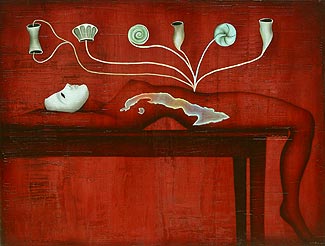
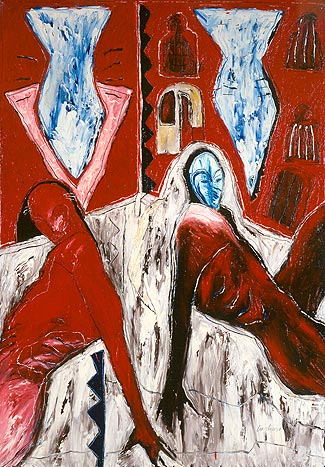
La tradición primitiva. Existen dos componentes primordiales en la pintura de Humberto Castro que lo enlaza con esa tradición. La primera es la máscara que el pintor utilizó sobre todo en una serie de cuadros pintados durante la década de los noventa. No hay que insistir mucho en la importancia de la máscara dentro de la pintura contemporánea, desde que los cubistas comenzaran a utilizarla. En uno de sus cuadros, The Iron Fish, el pintor rinde homenaje a una de las figuras enmascaradas de Les Demoiselles D'Avignon. Por otra parte algunos cuadros suyos tienden a lo totémico, y dentro de esa tendencia podemos descubrir la influencia de ciertas obras de Lam. Lam pintó una serie de cuadros (muchos en sepias, color favorito de Humberto Castro y otros al carbón) donde los cuerpos mostraban unas agresivas protuberancias en forma |
de cuernos. Estos mismos cuernos aparecen en más de una figura de Humberto Castro, estando ambos vinculados al arte de la Oceanía, donde encontramos en sus figuras totémicas numerosos ejemplos de lo mismo como también en los chamanes de la Columbia Británica. Es cierto que para Humberto Castro el uso de esas protuberancias adquiere en su obra otro significado de carácter psicológico, pero no cabe duda que siguiendo en este caso a Jung, su imaginación encuentra en el inconsciente colectivo formas que le sirven para reproducir sus propias visiones.
|
La galería Virginia Miller está presentando actualmente una magnífica retropectiva de la obra de este pintor donde se encuentran importantes ejemplos de sus distintas etapas. Cada una de sus pinturas y dibujos requiere una atención particular pues son como mini-espectáculos de un gran todo que su obra entera representa. Una vez que penetremos en ella, el pintor nos ofrecerá el Hilo de Ariadna para que lleguemos a su centro.
La exposición-restropectiva de Humberto Castro se encuentra abierta en la galería Virginia Miller hasta fines de enero de 2007. 169 Madeira Avenue, Coral Gables. Para más información, (305) 444-4493. Webiste: www.virginiamiller.com
|
|
top
From Cuba to Paris, his freedom trail
By Fabiola Santiago
Profile of an artist
Posted on Sun, Nov. 12, 2006
Humberto Castro's route to freedom was his art -- Havana-Paris-Miami, and now, New York -- and the journey is reflected in his enigmatic, poetic canvases.
Black birds in flight, a blue snail carrying the map of Cuba on his back, the haunting circle of an inner tube cradling a figure that may be dying or being born, or both.
Man and beast stitched into one in a painting Castro calls The Eternal Spiral.
The red ''apple of discord'' bitten into the shape of his island.
A creature spewed from a serpent's egg -- a desirable woman, or a monster, or both.
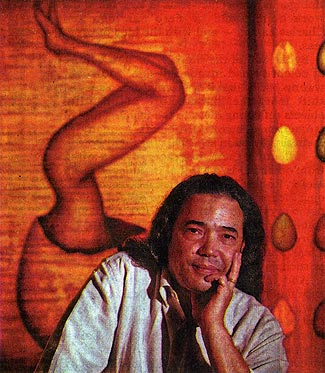
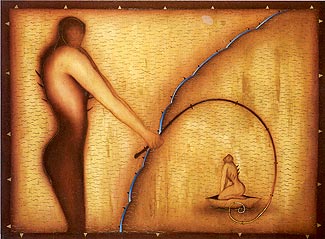
''I leave my paintings open to all kinds of readings,'' the 48-year-old artist says, standing in front of |
|
El pescador de almas (The Fisherman of Souls), one of the most striking pieces in his 15-year retrospective of paintings and drawings on exhibit at ARTSPACE/Virginia Miller Galleries in Coral Gables.
A member of the daring 1980s generation of avant-garde Cuban artists who broke through government censorship, launched independent art collectives, and for too short a moment, staged exhibits and performance art critical of the island's totalitarian regime, Humberto Castro left Cuba in 1989.
The owner of a Parisian gallery, who like many European art dealers began visiting Havana after the first biennial of 1984, offered him the opportunity to live and work in Paris.
''France was like a gift life gave me,'' he says of the 11 years he lived in the City of Light. ``It's my second homeland, a country that opened its doors to me.'' The transatlantic move immediately changed his award-winning art, which in Cuba was dark and critical, personified by drawings on paper and etchings of contorted, chained figures struggling to free themselves, and sculpture installations that featured distorted bodies and torsos upside down, as if taking a plunge into the floor.
|
|
From his early Paris era, the exhibit at Miller includes two paintings that are strikingly different from everything else -- his 1990 series Signs of the Zodiac. The Iron Fish and The House of Virgo, both exuberant in their splash of color, are revelatory of what happens when an artist is set free.
Celebration.
''I went wild,'' Castro says. ``It was cafe life, partying, living and working. I worked, then partied into the dawn hours, then worked again very hard.''
But it wasn't long until he returned, not to the darkness of his Havana drawings, but to his studied explorations of journeys and flight in yellows and reds, the chant of a free man looking forward and back. |
The style, still charged with the issues of confinement of his Cuba period but infused with color, remained his trademark through his move to Miami in 2000 in search of ''the experience of living in the United States'' and the connection to the exiled wing of his family.
''I needed the sun, to spend time in a place with a tropical climate,'' he says. ``I needed that light.''
From the beginning, Castro's approach to his work has been to create in series, using mythological themes and figures like the Minotaur, Icarus and Ulysses to explore the labyrinths in the struggle for power and the human desire to flee confinement.
OTHER VOYAGERS
In the process, his art speaks of contemporary migration -- he notes that Cubans are not the only ones fleeing their circumstances in treacherous sea voyages in which the waves become ominous, ``like a wall.''
Born in Havana in 1957, Castro comes from a family with no connections to the art world, but one that supported his early fascination with paints and pencils.
''I wanted more and bigger boxes of them and my grandparents indulged me and bought them for me,'' Castro says.
His only familial ties to design came by way of his uncle, Emilio Castro, an architect who designed most of the sports stadiums in Cuba (he died two years ago). Emilio's brother, Castro's father, Humberto Castro Díaz, owned the nightclub Cabaret Nacional before the triumph of the Cuban Revolution in 1959.
Castro's mother, Lucía María García, was a housewife and her side of the family supported the Revolution. His parents divorced after his father's business was confiscated by the new government and he was sent to prison for one year ''for the crime of owning a nightclub prior to 1959.'' His father fled the country shortly after his release and came to live in the United States. He died recently. His mother remains in Cuba.
''Mine is the typical story of the Cuban family split apart by the Cuban Revolution,'' Castro says.
After his talent for art became apparent, Castro followed the formal art education channels in Cuba, starting at the prestigious San Alejandro Institute at 14 and studying alongside breakthrough artists like José Bedia and Rubén Torres Llorca. Like them, Castro went on to higher studies at Instituto Superior de Arte and became part of a generation that radically changed the Cuban art scene.
Castro's series of black-and-white drawings in 1981-82 depicted distorted human figures bound by wires, sporting pins coming out of their heads, and always looking pained but struggling to break free. It is powerful work, reminiscent of the paintings of the Cuban master Antonia Eiríz (1929-1995).
Castro avoided the censors by telling them the figures represented the indigenous population massacred by Spaniards. He went on to win many prizes for his artwork, both in Cuba and abroad, in Germany, Puerto Rico and Poland.
While Bedia and Torres Llorca created Volumen I, the best-known exhibit of that generation and an unprecedented collection of critical art, Castro founded the group Hexágono with artist Consuelo Castañeda and some photographers. Many other artists formed similar groupings in those years to stage performances, collaborate on exhibits, and to protect themselves from being singled out for prosecution as traitors.
|
``I was lucky enough to live in years when there was a little bit of an opening, where we broke with the socialist realism that had been imposed in the [1960s and 1970s] era of painting militants, peasants, tanks and the figure of Fidel.''
He got to travel, Castro says, ``because I won so many prizes abroad that they had to let me go.''
Once, he was sent to Moscow after he won a drawing prize at a Berlin show.
``I was supposed to go to Berlin, but for some reason they said, not there. There was a trip of cooperation between Cuba and the Soviet Union, so I could go to that. And I said to myself, fine, I'll go. At least I get to see The Hermitage.'' |
|
With the collective, he staged performances on the beach, at Galería Habana, and even at Castillo de la Real Fuerza, a fortress built in 1558-77 to protect the city from invasion. Castro's pieces were all gray, black and metal and spoke volumes about repression.
''It was a very fruitful time,'' Castro says. ``It wasn't so much that we opened anything, but that we came with new ideas and the influence of [Soviet] glasnost made it so that there were some people in the government who wanted to open up.''
The '80s generation, Castro and other artists and curators from that era say, was able to stage ''conflictive exhibits,'' largely because of Marcia Leiseca, a progressive vice minister of culture who allowed it.
''People were sure that there was a desire to change,'' he says.
But when the government began to shut down exhibitions after just a few days, it soon became obvious ''they weren't going to put up with the criticism,'' Castro says.
That was the case of his 1989 exhibit titled Poder y existencia, Power and Existance, featuring somber paintings in grays, muted blues, olive greens and black-and-white, as well as metal pieces and text that was ``socially reflective.''
Leiseca was removed from her job, and the last Castro heard, she had been sent to Mazorra, the Havana mental hospital.
As for Castro, he accepted the invitation from France and became somewhat alienated from all that. ''In France you don't hear talk of Cuba everyday -- unless a musician is coming to play,'' he says.
Castro, whose work also was exhibited as a retrospective at the Museum of Art in Fort Lauderdale in 2001, doesn't give the story of his life as much weight in his art as some art critics do.
''Life in a way does influence the work of an artist, but I channel my work very consciously,'' he says. ``In every series there is a theme of study that I work through composition and color.''
A TRAVELER
He is now living in New York and plans to spend at least a year there, although he is also keeping a house in Miami and travels to Paris frequently.
''I'm the kind of person who likes to move, to insert myself in a new culture, to acquire new friends,'' Castro says. ``Some people like stability. I like change. If I could live each year in a different city I would.''
He chuckles at the irony of his Cuban wife's name -- Gipsy, a website designer who also studied at San Alejandro, and always accompanies him on his journeys. They have a 2-year-old daughter, Carolina.
Castro is now working to expand on canvas his last exhibit at the Kendall campus gallery of Miami Dade College, three installations titled The Hunter, The House, and The Bait.
The installations included a 12-foot tall man -- ''the hunter'' -- walking on a tight-rope with his arms extended. The bait: 12 oars against a wall, and in each oar, a piece of an arm, a hand, a head.
When he's done, Castro says, he expects that ''the new winds of New York'' will inspire his next voyage.
Fabiola Santiago is The Miami Herald's visual arts writer. |
top
Preface to “Humberto Castro, The Paris Years”
by Jorge Hilker Santis
Curator of Collections
Museum of Art, Fort Lauderdale
Humberto Castro’s oeuvre can be accurately described as enigmatic. His colorful canvases affect us like visual puzzles which intertwine reality and fantasy. Like a poet, Castro imbues his images with lyrical nuances without diminishing their impact. His discourse fuses mythological episodes with current events. In Castro’s able hands, gods become mortals and vice versa. Their struggle, pain and triumph gain a universal resonance enticing our senses and intellect.
Castro’s style is rooted in equilibrium: elements harmoniously complimenting and contrasting each other. Content never overwhelms design. His paintings are as much about concepts as they are about draftsmanship, color, texture, and light. In a symphonic fashion he avoids dissonance while accomplishing aesthetic unity.
The Museum of Art, Fort Lauderdale is honored and proud to host the exhibition “Humberto Castro: The Paris Years.” It is the first solo show at a major public gallery in the United States for the internationally known Cuban-born artist. This exhibition reiterates MOA’s commitment to spotlight the most remarkable
|
|
| Latin American artists in our midst. The project is further enhanced with an insightful essay by Professor Ricardo Pau-Llosa, and would not have been possible without the financial support of Dr. and Mrs. Pearl & Stanley Goodman and the AXA Foundation. To them, as well as to Mr. Castro and his wife Gipsy, we offer our sincere gratitude. Their join efforts allow us to showcase the elegant and poignant merger of ancient legends with contemporary issues. |
¿Qué pasa en Miami?
by
Art Premium
December 2006
ArtSpace/Virginia Miller Galleries
Primera retrospectiva de
Humberto Castro
La primera retrospectiva de este renombrado artista cubano de la generación de la década de los ochenta se celebrará en ArtSpacelVirginia Miller Galleries en Coral Gables a partir de noviembre de 2006.
El curador e historiador de arte Giulio V. Blanc, ya fallecido, expresaba que las frecuentes referencias de Castro a la mitologla revelan una amalgama entre su gran destreza como artista y pintor y las |
|
ralces que dejó en su lar nativo. "La separación de su familia y amigos, asI como la exploración de tierras extrañas, son temas predominantes que le lievan a desarrollar una mitologIa de escala homérica", opinaba. Esta mitologIa se vislumbra, por ejemplo, en la obra Minotauro en el laberinto e Icaro. Las alas de este filtimo, derretidas, recuerdan las "alas" de los cientos de cubanos cuya salida de Cuba dependIa de una embarcación que al final terminarIa desintegrada entre las olas. Castro puntualiza asI el riesgo de que el laberinto no tenga una salida segura."Para aquellos ajenos al conflicto caribeño, el discurso visual de Castro combina episodios mitológicos y eventos actuales con un alto grado de fuerza lIrica", opina Jorge Hilker Santis, Curador de Colecciones del Fort Lauderdale Museum.
Al igual que otros artistas cubanos de su generación, Castro estudió en la Escuela Nacional de Bellas Artes San Alejandro y el Institute, Superior de Arte. A finales de los setenta, Castro ganó varios premios en competiciones de pintura, dibujo y litografIa.
Desde el 1981, Castro ha participado en numerosos certámenes y exhibiciones individuales y colectivas en Europa, Sudamérica y los Estados Unidos, entre otros. El artista vivió en Paris desde 1989 a 1999. En la actualidad reside en Miami.
La exhibición estará abierta al püblico hasta enero de 2007. |
Humberto Castro
by Irina Leyva
ArtNexus No. 64 - Dec 2006
version en español
The Virginia Miller Gallery in Coral Gables inaugurated a retrospective of works created over the past fifteen years by the Cuban painter Humberto Castro. Titled “Humberto Castro: Pinturas y dibujos, 1990–2006,” the show comprised fourteen paintings and three drawings.
In Castro’s work, three style periods could be discerned: one comprising his paintings of 1990; a second one of works from 1993 to 1994; and a third one beginning in 1995. The 1990 works covered the transition between the 1980s and what was to come in 1993. In this first period, Castro’s figures were still connected to the “bad painting” style for which he was known in the 1980s; bright colors were retained, but the spatial distribution that would characterize his future works was already visible. Two works from this transitional period were included in the retrospective, El pez de hierro and La casa de virgo.
Between 1993 and 1994, Castro’s works stood out for their lyrical qualities. In that period, he explored the philosophical theme of the Minotaur in his labyrinth. Form of contorted bodies conveyed the artist’s inner preoccupations and existential concerns stemming from his condition as an exile in Paris during those years. Two canvases from this period were included in the show, both from 1994: La espiral eterna and Viaje imaginario. These were large-format works, with a palette that had been greatly reduced in comparison to previous works. They were characterized by a combination of red-beige and ochre, resulting in dramatic contrasts.
The show’s three drawings were also from this period, two from 1993 and the third from 1994. Made in ink, the figures were resolved through a combination of shadows and contours that created a floating sensation. The topic of these drawings was still the Minotaur, which Castro explored extensively during that time.
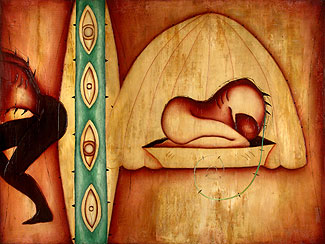
Beginning in 1995, new structural changes became evident, and the palette shifted. Castro’s lines became simplified, and there was a new use of pure and forceful colors, perhaps a consequence of his return to the tropics; in 1999, Castro moved permanently from Paris to Miami. These shifts were more visible in his works of 2000, with backgrounds in flattering colors and figures that appeared more isolated, reflecting a period of introspection. Castro continued with his exploration of the human form and his philosophical investigations, with the topic of exile more latent but visible through very concrete symbols. Among these were boats, the presence of the sea, and maps of Cuba. Summarizing this state of being were two works: Sueño transcurriendo, from 1995, which represented a figure in a fetal position inside a boat, as in an dreamlike journey to its origins, and La lección de anatomía, from 2000, in which the map of Cuba was portrayed in silhouette with a mask.
Two works dealt with the consequences of exile. One was Comme des poissons, from 1998, which displayed two figures, hybrid creatures that were half-human and half-fish; between them was a pendulum. Castro speaks of the figures’ evolution, of their responses to different aspects of the new life one faces after emigration. The second work touching on this topic was Traversee, from 2000, which presented a human figure carrying a snail and spoke of the exile’s perpetual motion and instability.
In a general sense, the show was carefully prepared and provided a balanced selection of Castro’s works. One unifying feature running through Castro’s oeuvre, independent of period or style, is its autobiographical character with a central theme of humanity and its emotions. This retrospective marked the end of a creative period in his career and announced the start of a new one.
Humberto Castro
Autor: Irina Leyva
ArtNexus No. 64 - Dic 2006
english version
Una retrospectiva de la obra de los últimos quince años del pintor cubano Humberto Castro se inauguró en la Galería Virginia Miller de Coral Gables. Titulada “Humberto Castro: pinturas y dibujos, 1990-2006”, la muestra consistió en diecisiete obras; de ellas, catorce pinturas y tres dibujos.
En esta exposición pueden delimitarse estilísticamente tres períodos: uno que comprende las obras de 1990, uno segundo de 1993 a 1994, y el tercero, a partir de 1995. Las obras de 1990 cubren el proceso de transición entre la década de los ochenta; y las que vendrían después, a partir de 1993. Las figuras todavía tienen puntos de contacto con el estilo bad painting por el que era conocido Humberto Castro en los ochenta, mantiene el colorido brillante pero a la vez empezamos a ver la distribución espacial que caracterizaría su obra en el futuro. De esta transición hay dos obras en la retrospectiva, El pez de hierro y La casa de virgo.
Entre 1993 y 1994, las obras que produce resaltan por su lirismo. Durante este tiempo hace obras en las que exploraba el filosófico tema del minotauro en su laberinto. Cuerpos contorsionados mostraban de cierta manera las inquietudes internas del artista, sus preocupaciones existenciales devenidas de su condición de exiliado, ya que por estos años estaba viviendo en París. En la muestra se presentaron dos piezas en tela de esta etapa, ambas de 1994, tituladas La espiral eterna y Viaje imaginario. Estas obras son de gran formato y con una paleta de colores reducida con respecto a sus obras anteriores. Se caracterizan por una combinación de rojo/carmelita con ocre, dando como resultado un contraste dramático.
Los tres dibujos de la exposición son de este período, dos de 1993 y uno del 1994. Ejecutados en tinta, las figuras están solucionadas a partir de una combinación de sombras y contornos, dando la sensación de estar flotando. El tema de los dibujos continúa siendo el del minotauro, temática que exploró extensivamente en la serie producida entre estos dos años.
A partir de 1995 comienzan a advertirse cambios estructurales y en su paleta. Se simplifican las líneas para dar paso a un nuevo uso de colores más puros y fuertes, probablemente una consecuencia de su retorno al trópico, ya que, en 1999, Humberto Castro se muda permanentemente de París a Miami. Estos cambios son más visibles en las piezas del año 2000, en las que los fondos son de colores más planos y las figuras comienzan a aparecer más aisladas, reflejando un período de introspección. Continúa con sus exploraciones del cuerpo humano y sus indagaciones filosóficas, haciéndose más latente el tema del exilio, iconográficamente más visible a través de símbolos bien concretos. Entre estos símbolos se destacan botes, la presencia del mar y mapas de Cuba. Entre las obras que resumen este estado de ánimo pueden mencionarse dos específicamente: Sueño transcurriendo, de 1995, en la que plasma una figura en posición fetal en un bote, en un viaje onírico a sus orígenes; y La lección de anatomía, de 2000, en la que se delimita el mapa de Cuba en una silueta con una máscara.
De las obras en las que trata las consecuencias del exilio podríamos citar dos en específico. Una de ellas es Comme des poissons, de 1998, en la que aparecen dos figuras, criaturas híbridas mitad humanas, mitad pez, y viceversa; en el medio de ambas, un péndulo. Humberto Castro habla de la evolución de cada uno, de las respuestas ante diferentes aspectos de la nueva vida a la que nos enfrentamos una vez que emigramos. Las caras son desdibujadas, carentes de una identidad, una alusión al proceso de transformación por el que pasa cada uno en su nueva vida. Otra obra que toca esta temática es Traversee, de 2000, en la que aparece una figura humana con un caracol a cuestas, hablando de la perpetua movilidad y la inestabilidad del exiliado.
En sentido general, la muestra fue cuidadosamente preparada teniendo en cuenta una selección balanceada de las obras del artista. Puede apreciarse una característica que unifica toda la obra de Humberto Castro, independientemente del estilo y período de creación, y es el carácter autobiográfico de la misma, manteniendo como tema central al ser humano y sus emociones. Esta retrospectiva marca el final de una etapa creativa en su carrera y el comienzo de una nueva.
top
|