Artistic Stroll by Key Biscayne Magazine

Aside

Published by Key Biscayne Magazine – May 2013 P32

Key Biscayne Magazine

Key Biscayne Magazine

With Coral Gables Gallery Night, gallery owner Virginia Miller helps get people out of the house and into some of the city’s hottest art spaces.

Love art? Then head to Coral Gables on the first Friday of every month for the city’s Gallery Night. During this regular free event, Coral Gables’ galleries open their doors for art lovers walking or taking a free trolley as they explore, meet new and old friends, and get stimulated by new and exciting artwork. The event is the brainchild of Virginia Miller, owner of the ArtSpace/Virginia Miller Galleries, who saw it as a chance to give Coral Gables nightlife a boost and celebrate the area’s thriving art scene. It’s also a great opportunity to make new connections. In fact, Miller knows of at least 3 couples who had their first meetings in her gallery. “The human imagination is limitless, and contemporary art offers us a wonderful opportunity to expand the horizons of our creativity,”
she says; 169 Madeira Ave., Coral Gables; 305.444.4493; VirginiaMiller.com.

American Memories by Leslie Lew

Featured

‘AMERICAN MEMORIES’ BY RENOWNED AMERICAN NEO-POP ARTIST LESLIE LEW OPENS MAY 3RD AT ARTSPACE/VIRGINIA MILLER GALLERIES IN CORAL GABLES

Leslie Lew, Personal Problem-Dear Abby, Sculpted Oil on Canvas, 16 x 12 inches, 2012

Leslie Lew, Personal Problem-Dear Abby, Sculpted Oil on Canvas, 16 x 12 inches, 2012

Mickey Mouse, Popeye, Wonder Woman, Animal Crackers and Kellogg’s Frosted Flakes are some of the subjects of works in “American Memories,” a one-person exhibition of paintings and sculpture by Leslie Lew that opens from 6-10 p.m. Friday, May 3rd at ArtSpace/Virginia Miller Galleries.

“Leslie is a contemporary, neo-Pop version of Norman Rockwell,” said ArtSpace/Virginia Miller Galleries’ owner and director Virginia Miller.

“I’m grabbing memories,” says the artist. “Some of these are starting to fade.”

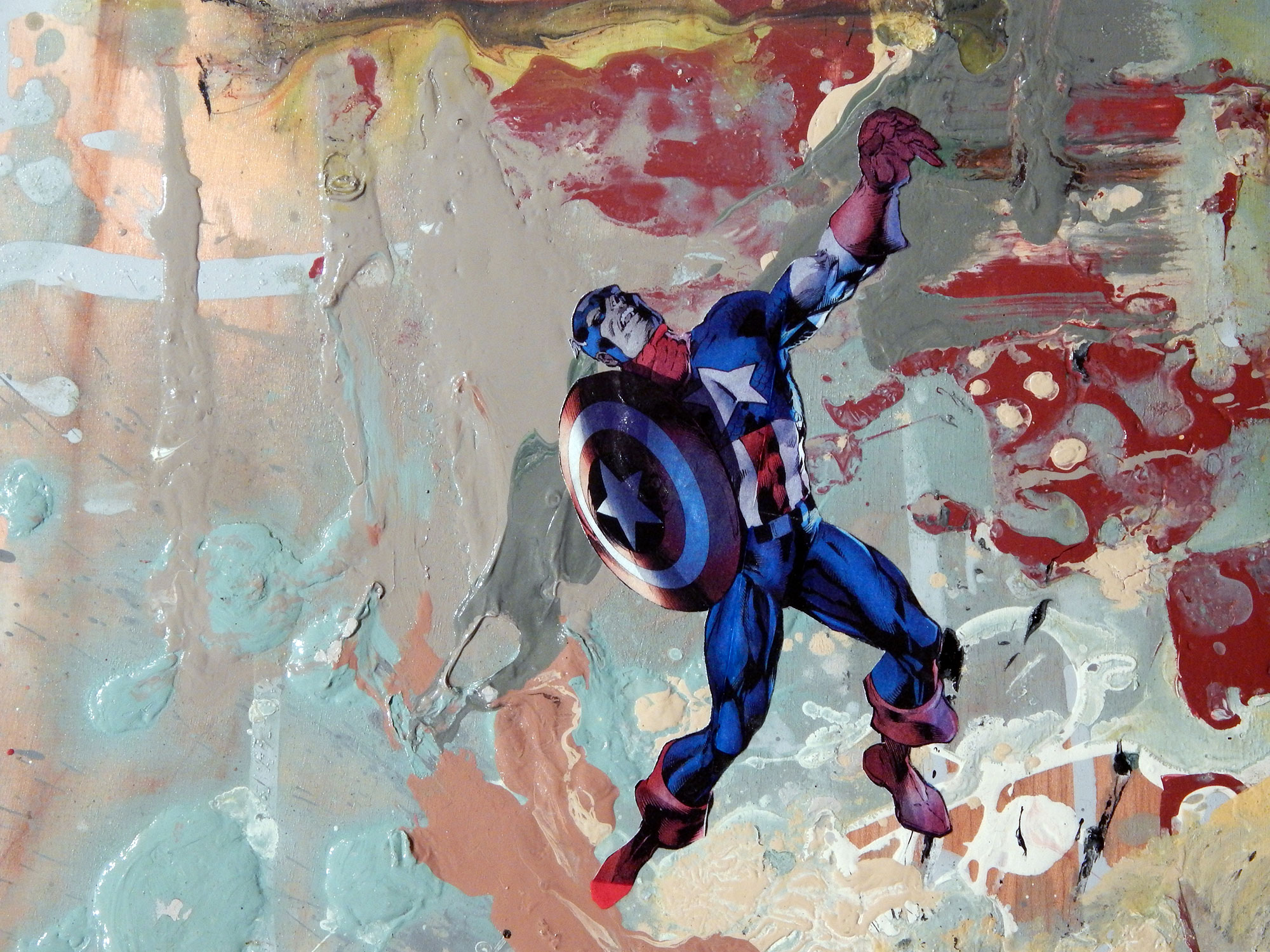
Featuring some of America’s most iconic images, Leslie Lew offers a nostalgic trip back to childhoods ranging from the 1930s to 1970s. Permission from The Walt Disney Company, DC Comics, and the Kellogg Company allows her to re-create comic book covers of America’s most beloved childhood heroes along with perennially favorite breakfast cereals.

“When faced with the legendary things and characters of our youth, rendered with unrestrained enthusiasm, it’s hard not to smile, to remember the pleasure of eating Animal Crackers, toting the box on its little white string; to feel a little girl’s aspiration to be Wonder Woman, and to be transported by cartoon lives—so familiar and yet so unlike our own,” noted Kathy Greenwood, a curator for Albany, NY International Airport’s Art & Culture Programs.

Leslie Lew, Spiderman 1, Mixed Media Monotype on Canvas, 18 x 13 inches

Leslie Lew, Spiderman 1, Mixed Media Monotype on Canvas, 18 x 13 inches

Contributing to the impact of her paintings is the artist’s special technique, which she calls “sculpted oil,” paintings on canvas in high relief to create a three-dimensional effect.

After earning her BFA and MFA from the School of the Art Institute of Chicago in 1982, Lew was one of a dozen artists selected to participate in a Whitney Museum studio program. She became a leading artist in New York’s East Village Art Movement, where she was friends with Jean-Michel Basquiat, who introduced her to Andy Warhol at her first opening in New York.

Lew lived and worked in a large Gramercy Park loft just above Julian Schnabel’s. Other well-known artists in the group included Robert Rauschenberg, Roy Lichtenstein, Kenny Scharf, and Keith Haring.

“Keith, Jean-Michel and Andy did a show of matchboxes in a pop-up gallery on 6th Street with me and other artists,” she recalls. “I did a painting of the opening, and I put Andy in the corner of it with his little Brownie camera. Andy loved young artists—he was always looking for the next new thing. He helped me a lot, introducing me to all sorts of people. We hung out together.

“I did my version of Andy’s silkscreen, ‘Moon Explorer,’ and he thought it was a hoot. He asked me to do a trade with him—my ‘Moon Explorer’ for one of his ‘Marilyns.’ Then he went into the hospital for a gall bladder operation and he died. I helped to archive all of his work for the foundation.”

Leslie Lew, Felix Juggling Nine Lives, 80 x 53 inches, Sculpted Oil on Canvas, 2007

Leslie Lew, Felix Juggling Nine Lives, 80 x 53 inches, Sculpted Oil on Canvas, 2007

Today Lew’s painting of “Moon Explorer” is owned—appropriately—by U.S. astronaut Robert C. “Woody” Spring. Her works are included in dozens of major collections, including those of Si Newhouse, the Tisch Family, Conde Nast, MCA Records, Sylvia Miles and Cyndi Lauper in New York; the Sainsbury Collection in London; and the Mayo Clinic in Minnesota.

“My first painting of ‘Animal Crackers’ is in the lobby where children are admitted to the Mayo Clinic,” she said.

Lew has participated with the superstars of the contemporary art world in a number of other exhibitions. To cite only three:

In 1985 the Holly Solomon Gallery exhibition “57th between A & D” included works by Andy Warhol, Alex Katz, and Roy Lichtenstein with East Village artists Jean-Michel Basquiat, Keith Haring and Leslie Lew. The following year Lew and Warhol were among the artists in “The East Village” exhibit curated by Richard Martin, editor-in-chief of “Arts Magazine”, at the Fashion Institute of Technology. Lew and Warhol also were in “Small Works by Major Thinkers” in 1986 at the Bess Cutler Gallery in New York.

The “Cafe Vered” show at Vered Gallery in East Hampton in 1995 included “Animal Crackers” by Lew along with works by Janet Fish, Audrey Flack, Red Grooms, Donald Lipski, Larry Rivers, Donald Sultan, Andy Warhol and Tom Wesselmann, among others.

Leslie Lew, Wonder Woman Again Saves the Day, Sculpted Oil on Canvas, 38 x 28 inches, 2000

Leslie Lew, Wonder Woman Again Saves the Day, Sculpted Oil on Canvas, 38 x 28 inches, 2000

Lew has exhibited in numerous other prestigious venues, such as Jack Tilton and OK Harris galleries in New York City; the Light Gallery in Los Angeles and Hamilton Galleries in Santa Monica; and in a number of museums here and abroad. In Manhattan, for example, her paintings have been included in exhibitions at the Visual Arts Museum, Parsons School of Design, SoHo Center for the Visual Arts, the Henry Street Settlement Museum, and the Alternative Museum. Lew’s paintings have been included in travelling exhibitions of the Carnegie Mellon Museum and Guggenheim Museum in this country and in shows in Amsterdam, Berlin, Copenhagen, St. Petersburg, and Sofia, Bulgaria.

In Miami, Lew is included in the Martin Z. Margulies Collection, “recognized as one of the major collections of contemporary art in the world,” according to Newsweek critic Peter Plagens.

According to critic Peter Frank, “by appropriating two or three generations of imagery, from wartime cartoons to cold-war-era reading primers to the streamlined sci-fi fantasies of the space race, Lew seems to mark off the growth spurts of mid-20th Century America…Lew re-enacts the recent evolution of American visual culture without having to depict it. A child of our time, Leslie Lew has appropriated Pop Art itself.”

Leslie Lew, Surprise Mickey, Mixed Media Monotype on Canvas, 18 x 14 inches

Leslie Lew, Surprise Mickey, Mixed Media Monotype on Canvas, 18 x 14 inches

“We are delighted to have this opportunity to introduce yet another historically significant artist to our clientele,” said Virginia Miller. “Leslie Lew’s work is an absolute joy.”

“American Memories” will be exhibited at ArtSpace/Virginia Miller Galleries from May 3rd through July 2013. Along with our opening reception on Friday, May 3rd, additional receptions for this exhibition will be held from 6 to 10 pm on Friday, June 7th and July 5th.

Gallery hours are 11-6 Monday through Friday and by appointment on Saturdays and evenings. For more information, call 305-444-4493 or visit the gallery web site, www.virginiamiller.com.

“A CHILD OF OUR TIME, LESLIE LEW HAS APPROPRIATED POP ART ITSELF.” Peter Frank, Critic and Curator
Pasadena Museum of Art

“LEW’S SUBJECTS ARE WHIMSICAL, NOSTALGIC SNAPSHOTS OF AMERICA’S PAST.” Magdalin Leonardo
Inside Chappaqua Magazine

“AN ENERGETIC, EXUBERANT TREATMENT THAT IS VISUALLY EFFECTIVE.” Phyllis Braff, Critic
The New York Times

Leslie Lew: American Original Follows a 3,500-Year-Old Tradition

Aside

Leslie Lew, Wonder Woman Making a Splash, Sculpted Oil on Canvas, 60 x 36 inches, 2012

Leslie Lew, Wonder Woman Making a Splash, Sculpted Oil on Canvas, 60 x 36 inches, 2012

American Pop artist Leslie Lew, who has been creating her unique “sculpted oils” for 30 years, actually is following a 3,500-year-old artistic tradition that art historians believe began on the island of Crete, site of the earliest known frescoes.

Unlike paintings done onto walls, frescoes are painted while their plaster base is wet—thus the term, “wet-on-wet”—so that the pigments are absorbed into the drying plaster. Because the pigments are part of the wall, they are not as vulnerable to the myriad threats to paintings applied only on the surface, and they have endured for centuries.

Using the wet-on-wet technique with oil paints, Lew swiftly applies various coats of paint onto the base layers while they are wet, creating a high relief for her special three-dimensional effect.

“I start with a blank canvas that I sketch out with all the drawing and detail. I then go into it by mounding titanium white acrylic paint with brushes to create the forms. I go back with thick oil paint, wet on wet, until I finish the painting. I only work on one painting at a time.

Lew explains that at first, she used a base of layers of oil paint. “The earlier paintings before 1992 were created entirely in oil paint, without the foundation of titanium white acrylic.” But she notes that oil paint can take up to 200 years to dry, this created subsurface problems, so she switched to the quick-drying acrylic for a stable base layer.

Virginia Miller, owner and director of Greater Miami’s longest-established fine art gallery, says that in her more than 40 years’ experience in art she has never seen anyone who creates high-relief oil paintings of nostalgic subjects like Lew. In Miller’s words: “Leslie Lew is truly an American original.”

Leslie Lew: American Neo-Pop Artist

Aside

The Pop art movement, thought to have originated in 1947 with the painting “I Was a Rich Man’s Plaything” by Scottish artist Eduardo Paolozzi, emerged in the mid-1950s in Great Britain and by the late 1950s had begun to upstage Abstract Expressionism.

Characterized by such subject matter as mass-produced objects, advertising, comic characters and other aspects of mass culture—think of Andy Warhol’s soup cans and Roy Lichtenstein’s comic-strip characters—Pop art was recognizable and understandable by anyone.

Leslie Lew, who began exhibiting in 1981, follows in the tradition of the earlier American Pop artists by depicting such well-known characters from comic strips as Mickey and Minnie Mouse, Snow White, Popeye, Superman and Wonder Woman. Her other subject matter comes from common early childhood experiences: popular 1940s-era primers and the universally loved Animal Crackers.

Leslie Lew, Sugar Smacks, Sculpted Oil on Canvas, 48 x 36 inches, 2007

Leslie Lew, Sugar Smacks, Sculpted Oil on Canvas, 48 x 36 inches, 2007

Disney characters are some of her favorite subjects. I’m honored to have the approval to create some of the most special Disney images,” she notes.

“All of my work deals with memories and growing up in America,” Lew says. “Disney in the 1930s, ‘40s and ‘50s had some of the most beautiful comic covers, much like the illustrated movies that came out from that studio, including ‘Snow White,’ ‘Cinderella,’ and ‘The Sorcerer’s Apprentice.’

“They’re not just relevant today, but are still the most beautifully illustrated comics ever. I feel that I’ve captured these images so they can again be enjoyed by all.”

Leslie Lew’s first exhibition at ArtSpace/Virginia Miller Galleries will open on Friday, May 3, 2013 and will include sculpted oil paintings and sculpture, cast paper paintings and monotypes.

Bassmi

California Dreamin’ in Miami By Elisa Turner

Aside

Casper Brindle, Stratum 10, Acrylic, Wood, Resin, 29 x 49 x 2.5 inches, 2010, CBR5

Casper Brindle, Stratum 10, Acrylic, Wood, Resin, 29 x 49 x 2.5 inches, 2010, CBR5

ArtPulse Reviews
California Dreamin’ in Miami
By Elisa Turner

The exhibit “IMPACT: Emotions of Color” at ArtSpace/Virginia Miller Galleries in Coral Gables does indeed pack a stunning, colorful impression. Expertly hung and lit, with plenty of room for the 32 paintings by five artists to breathe so that viewers are not bombarded with a surfeit of visual stimuli, it presents the California infused work of Lisa Bartleson, Casper Brindle, Ned Evans, Andy Moses and Suzan Woodruff.

These artists are clearly heir to the ground-breaking accomplishments of California artists showcased in the much discussed recent series of exhibitions collectively titled “Pacific Standard Time: Art in Los Angeles 1945-1980.” This was a major collaboration of more than 60 cultural institutions throughout Southern California. Together, they told the story of how the Los Angeles art scene came of age, eventually to pack its own sizable impression on the art world. These exhibitions took place from October 2011 to April 2012 and were initiated by the Getty Foundation and Getty Research Institute, with programs totaling more than $11 million.

So yes, we all know now, even if we did not quite get it before, that numerous California artists have made history, including those whose names we might not have encountered in standard art books. Veteran Coral Gables dealer Virginia Miller has brought to South Florida a savory taste of the Getty initiated West Coast art extravaganza by presenting work by artists too young to be part of “Pacific Standard Time.”

And what a taste this is. You can practically taste and smell the salt in the air, bask in golden sunlight morphing into lavender sunsets, hear waves pounding, see the excellent cresting surf that has seduced at least two generations of surfer artists in Southern California. Dazzling paintings by Andy Moses, which evoke swirling ocean currents glinting with light, particularly exemplify this link between being born to surf and born to make art. Real California guys, it would seem, can do both with dashing savoir faire, thank you very much.

Born in Los Angeles in 1962, Moses grew up surfing in places such as Santa Monica and Malibu while also hanging out in the artcentric milieu of his father, Ed Moses, now celebrated as one of the pioneering California artists of the postwar generation along with Larry Bell, Billy Al Bengston, Robert Irwin, James Turrell and Ed Ruscha.

Many artists active in that time and place are grouped in the “Finish Fetish” and “Light and Space” movements unique to Southern California in the 1960s and 1970s. These movements helped put Los Angeles on the map in the art world, recasting Pop Art and Minimalism with an L.A. love for gleaming cars and motorcycles, impeccably crafted surfboards, and Hollywood’s dream-and-fantasy factory. While manifested in different ways in the work of various artists, generally these movements cultivated a focus on immaculately produced surfaces and conceptual works exploring the process of visual perception. Art of this time and place also reflected a rebellious defiance of Southern California’s military industrial complex. Additionally, a sense of California’s brilliant and quicksilver light suffused many of these artworks, as it does today in the “IMPACT” show at Art Space Virginia Miller Galleries, so clearly in synch with the Los Angeles aesthetic.

Consider, for example, Morphology 601 (2012) by Moses. It’s a riveting abstraction that brings to mind swirling ocean currents as well as a dusky cloudscape blurring gracefully into twilight, yet all the while it is clearly an immaculately smooth surface shimmering with subtle gradations of color. His Akaringa (2009), also in this exhibit, demonstrates the delicious optical illusion of physically shifting color, which he creates by ingeniously working with a concave canvas.

The luminous interchange of light and color also fascinates Suzan Woodruff, although her approach to abstraction yields a greater sense of depth than found in works by Moses. Her paintings, never betraying the expressionist messiness of brushstrokes, often give viewers the bizarre illusion that they are looking through vaporous clouds or gazing down through deepening “layers” of water in the ocean, in which the color of the water becomes darker the further it is from sunlight above sea level. Her Water Dreams (2007) evokes a compelling confluence of light, air and water. At the top of the painting, there are pale silvery green patches, catching the eye with their luxurious opalescence. These contrast with the deeper shades of blue, evoking ocean depths or indigo twilights, converging near the lower portions of the painting.

Casper Brindle, Lisa Bartleson, and Ned Evans convey a keen, if not obsessive, sense of craftsmanship in their richly colored abstractions. This craftsmanship is clearly in line with the “Finish Fetish” aesthetic of earlier California artists, yet these later artists make this sensibility their own. In Stratum 4 (2010), Brindle achieves the impressive trick of making a gleaming rectangle of saturated yellow appear both resolutely flat and somehow evocative of indeterminate depth, as if one could gaze into the mysterious recesses of golden sunlight bathing the concrete wall of a nondescript apartment building or an unearthly calm ocean at midday. A simple maple strip of wood cleanly divides this painting in half, suggesting the horizon line separating sea and sky, a horizon line ever visible to coastal dwellers enamored with sun and surf.

Lisa Bartleson, Sphere XVI, Mixed Media and Resin on Panel, 48 x 48 x 3 inches, 2011, BAR4

Lisa Bartleson, Sphere XVI, Mixed Media and Resin on Panel, 48 x 48 x 3 inches, 2011, BAR4

Bartleson’s works of mixed media and resin on panel are created with innumerable tiny rectangles of plastic positioned to form expanding concentric circles in subtle gradations of color. These rectangles form a roseate shape at the center of her work. Some suggest misty aureoles of light surrounding the moon on a cloudy night or mandalas. Scale XXXX Sphere X (2011), with silvery gray shapes blending into subtle shades of violet and blue, may even bring to mind the overwhelming spirituality conveyed by “The Rose,” a massively legendary work composed mainly of one ton of white and gray paint by San Francisco Beat painter Jay DeFeo, obsessively created during the years 1959 to 1966.

Surely the “Senior Surfer” in this bunch, Evans moved to Venice, California, in the early 1960s and fell in thrall to the area’s twin siren calls to surf and make art. He not only surfed throughout Baja California but worked with abstract painter Billy Al Bengston, whose legacy was one of many recognized by the recent spate of exhibits in “Pacific Standard Time.” At Virginia Miller are numerous examples of Evans’ gently geometric abstract paintings, perhaps recalling vertical shafts of light as they intersect and pierce mammoth cresting waves or forested mountains of the Golden State. The paintings can, at times, seem as if the artist has overworked a familiar composition. Particularly interesting in this selection is the most recent painting on panel with the intriguing shape of an elongated oval. This is Otto (2010). (Three other smaller paintings on panel from 2010
are circular-shaped.) A dynamic variation on earlier work in this exhibit, it thickly but oh-so-gracefully layers muscular striations in fleshy shades of red and orange, almost like a cross-section of sinewy muscles needed to power through both waves and paint.

A gallery exhibit showcasing California imports in the Greater Miami area inevitably leads to this question: Why don’t art venues here collaborate to tell the story of the expanding Miami art scene? Such a collaboration in Miami, says Bill DuPriest of ArtSpace/Virginia Miller Galleries, “is a logical extension of what this is all about.” Given the presence in Miami of the Knight Foundation, a major national foundation with increasing interest in the arts, it would seem that perhaps such a concept is indeed possible and could attract other significant funders. Surely no one can expect the journalism focused Knight Foundation to do all the heavy lifting that the Getty Foundation and the Getty Research Institute were recently able to accomplish with “Pacific Standard Time.”

Then again, Miami may not be quite ready or mature enough for such a bold, collaborative move. It is no doubt typical of southern California’s mighty cultural resources that the superb show “Transcultural Pilgrim: Three Decades of Work by José Bedia” at the Miami Art Museum was organized by the Fowler Museum at UCLA. This outstanding exhibit, highlighting perhaps Miami’s best known artist, runs from May 24 through September 2, 2012, at MAM, which is set to reopen in the fall of 2013 in downtown Miami’s Museum Park as the Pérez Art Museum Miami.

When the name and location of the city’s central art museum are still evolving, it looks as though the chance to make history will have to wait.
(March 2 – July 31, 2012)

Elisa Turner teaches at Miami Dade College and is Miami correspondent for ARTnews. She has written for Arte Al Día, Art+Auction, ArtReview and The Miami Herald.

Suzan Woodruff

Casper Brindle